notanATS is not an ATS ... Duh!
Screening. Done differently. On purpose.
A real conversation with every applicant about work they have actually done. You get a ranked shortlist you can defend.
Strip screening back and it is two sentences.
“I need help with this problem.”
“I have solved something like it, and I like what you’re building.”
“I need someone to run this task.”
“I have run exactly that, end to end.”
“I want someone accountable for this.”
“I owned that number for two years.”
How is it different?
It changes two stages of your pipeline and leaves the rest alone.
- Your rubric comes from your requirements for that role, not a template.Nobody is scored against a competency model for the job title, and no two applicants get the same interview: each one’s résumé decides what they are asked about. Same bar for everyone, a different conversation with everyone.
- The AI is disclosed, typed, and never decides.No fake recruiter, no synthetic voice. It screens; a person makes every advance and reject call.
- Silence is over.Everyone who finishes learns how they compared against the real pool, automatically, when the role closes.
Your ATS keeps the requisition, the pipeline and the compliance record. notanATS hands you the shortlist; nothing advances or rejects anyone without a person deciding it. That is a design line, not a settings toggle.
How does it work?
A twenty-minute calibration builds the rubric.
The hiring manager describes what the role is there to solve, own or run, in a guided conversation that refuses answers too vague to measure anyone against. The criteria lock before the job link goes live.
And you stop being the translator: the manager’s bar goes straight from their head into the rubric, not through your notes.
How answers are measured against the criteria is not published, for the same reason you would not hand out the interview scoring guide with the job ad.
Thirty minutes about work they have actually done.
No résumé screen. The résumé decides what each applicant is asked about, their answers are measured against your criteria, and they start straight away or book a slot that suits them. Nobody coordinates calendars, and nobody is filtered out by a machine: applicants who miss a stated must-have drop out, everyone else is ranked for a person to review.
This is why you get to interviews faster: an applicant who applies tonight can be screened, scored and ranked before you open your laptop tomorrow.
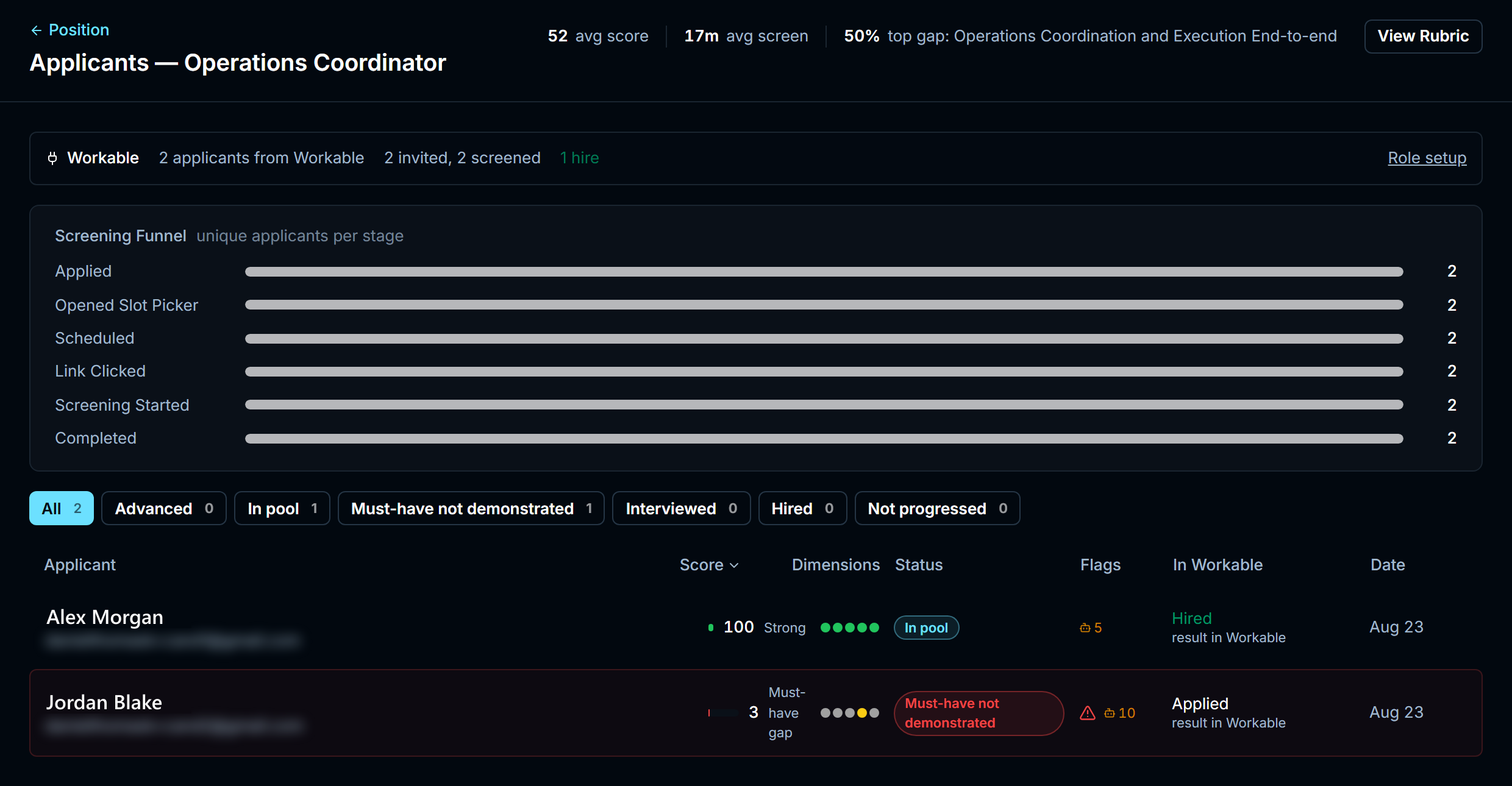
Ranked, scored per dimension, evidence attached.
Every result opens into the conversation that produced it, so when the hiring manager asks why these three and not the other thirty, you show them, line by line. You still choose who to interview. The system never rejects anyone.
“Thirty minutes, on my own clock, and I actually hear back?”
The applicant
No day off required
Start straight after applying, or book a slot that suits you: evening, weekend, lunch break. No call to whisper through from a stairwell.
Typed, on your terms
No camera, no voice, no trick questions. You see every answer before you send it.
Apply because you want this role
Thirty minutes of specifics feels long to someone who is only curious, and short to someone who actually wants the job. That filter is deliberate.
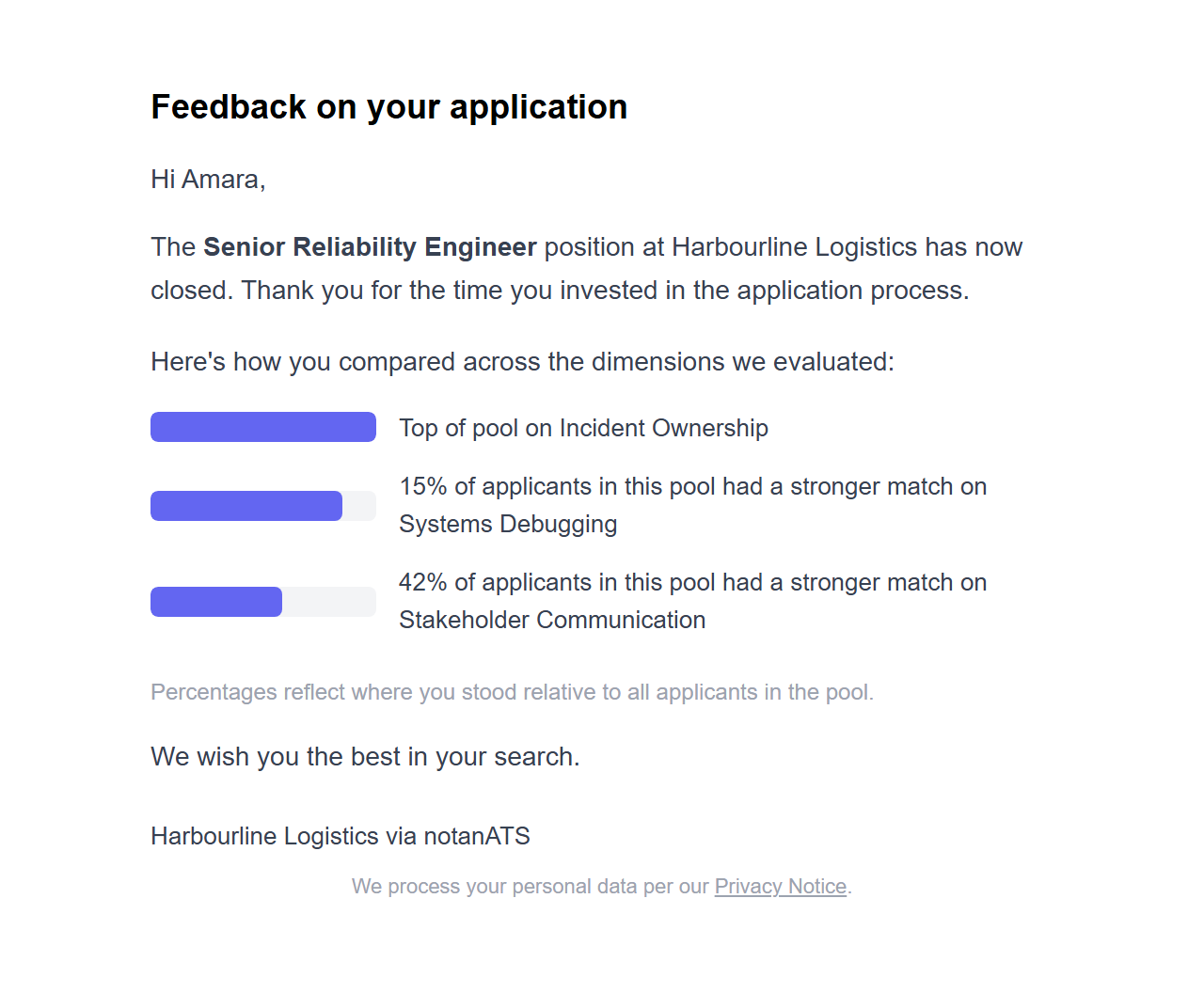
When the role closes, everyone who finished learns how they compared, per dimension, against the real pool, so they know where they stand for the next similar role. It is computed from the pool’s real scores and sent automatically. No company can write that by hand for every applicant, which is why the default everywhere else is silence.
Below three completed conversations the comparison is suppressed: a percentile drawn from two applicants would be theatre, and we will not send one.
Will it work for you?
Your ATS
Connect it once: applicants flow in, the shortlist flows back with scores and transcripts attached, and your pipeline stays the record.
Not using one at all? notanATS runs perfectly well on its own.
Your data
Generate a read-only key and point Claude at your own hiring data. The key can look, not touch, and it sees your organisation only. Then skip the dashboard and just ask:
- Which of my open roles has the weakest pool right now?
- How did the people we hired last quarter score against their pools?
- Where are applicants dropping out, and on which roles?
The bias question
Bias gets into screening through proxies: names, schools, accents, gaps, résumé polish. The two-sided calibration takes them out of the comparison. The manager calibrates what the role’s outcome requires before seeing a single applicant, and each applicant is scored on work they have actually done against that bar. What gets compared is work to requirement, never person to person. Self-identification stays voluntary, anonymous, sealed from the hiring manager, and has no effect on any result.
And because no process should be taken on faith, selection rates are tracked per pool, built to surface bias if it appears, with the evidence attached. We also ask applicants how the screening felt, and track whether they liked it.
No hiring process can promise the absence of bias, and we will not claim otherwise. What we promise is that everything here is reviewable.
What does it cost?
Nothing until you have seen it work. Every feature works as it does on paid: no restricted mode, no watermarks, no gotchas. Activate billing and everything you’ve built carries over.
- 2 postings included, with unlimited completed screenings
- No credit card required
- Full feature access
- Valid for 30 days from your first posting
- 10 completed screenings included per paid posting
- $2 per completed screening beyond the included 10
- Each screening counts toward the $99
- No per-posting fees
You pay for what you use. Not for seats, not for job posts, not for a bigger plan.
We only make money when you actually screen someone. That is deliberate. A subscription you forgot to cancel is not a business worth building.
Questions people ask.
The basics
What is notanATS?
notanATS is an applicant screening system, not an applicant tracking system. You describe what the role actually requires once; notanATS then runs the whole screening process against those exact requirements: every applicant assessed, scored on the same criteria, and ranked. Nobody reads a résumé to build the shortlist, and every applicant gets feedback on where they stood.
Who is this for?
Recruiters and hiring teams who see AI screening as a boon, not a threat. You want the screening handled properly so you can get to interviews faster, and you want an AI that knows its place: it screens, a person decides. Works for technical roles, operational roles, and leadership roles. The structure does not care about the domain. It cares about specificity. If you want an AI that makes the hiring decision for you, this is not your tool, and it is not going to become one.
Can this replace my entire ATS?
No, and it is not trying to. An ATS manages your pipeline: job postings, applicant tracking, offer letters, compliance paperwork. We handle one thing: screening. We sit between "applied" and "interview," and we do that part properly. The screened applicants you advance go into your existing system as your shortlist.
Ironic, given the name. We are aware.
This sounds like a gimmick. How do I know it actually works?
The hiring team defines what matters for the role. Applicants describe their experience against those same things. You see the evidence behind every result: the applicant's own words that supported it. It isn't a score handed down from nowhere; it's a record you can read and judge for yourself.
We would rather you see exactly how it fails than believe vaguely that it works.
For managers
How long does a manager take to set up a role?
About 20 minutes. You have a calibration conversation where the system asks what the role needs, what experience matters, and how you want the work done. It challenges vague answers until the criteria are specific enough to measure. If your answers are vague and generic, it will take longer. You are not filling out a form. You are describing the role the way you would explain it to a smart colleague.
Can I customize what the assessment looks for?
Every role is calibrated on its own. You define the problem the role actually needs solved and the experience that matters, and the assessment then holds every applicant to that role-specific definition. Nothing is scored against a template for the job title. The criteria are yours; how answers are measured against them is not published.
Do I get the conversation transcript?
Yes. The full conversation, every message from both sides, is available on the applicant detail page. Alongside it you get the evidence behind each result: which criteria were met and the applicant's own words that supported them.
Can I try it with my team before running a real job?
Your first two postings are at no cost, with unlimited screenings and no card required. Post a real role or a test role; we do not police the difference. If you want to see how the calibration and scoring work, just create a posting and run yourself through the applicant side.
The best demo is the product. We do not trust slide decks.
What if I realize my criteria were wrong mid-process?
Your criteria lock before the first applicant sees the link, and everyone already screened keeps the score they earned against the bar they were told about. What you learn from the interviews sharpens the bar you set next time. Re-scoring old answers against new questions is not fairness; it is retrofitting.
The locked bar is the point. Applicant number 12 is not judged by a rule written after applicant number 40.
What if an applicant lies or exaggerates?
The conversation is grounded in work the applicant says they have actually done, and the hiring team sees the full transcript alongside the evidence behind every result, so nothing rests on a score by itself. We do not publish how answers are assessed.
We cannot catch every lie. We can make lying harder than telling the truth.
What stops an applicant from using AI to answer the questions?
Copy and paste is disabled in the conversation, and detection runs underneath it: pasted or machine-generated input leaves signals, and when we see anomalies we flag them to the hiring team alongside the transcript instead of silently rejecting anyone. How the detection works is not published. Then ask what gaming the screen would actually buy an applicant: an interview, in person, holding claims they cannot back. The screening only decides who gets talked to.
It is a strange thing to cheat your way into.
For applicants
How do applicants start the conversation?
After submitting their application, applicants choose: start the screening immediately, or schedule a 30-minute slot for a later time. No account creation, no password, no app download required either way. If they schedule, an access link is emailed to them at the start of their booked slot. The link is valid for that 30-minute window only. If they start now, they go straight into the conversation from the application page.
Is the applicant talking to an AI?
Yes. The screening conversation is AI-guided, but it is not a chatbot quiz and it is not a black box. It is a structured discussion about work the applicant has actually done. The hiring manager reads every word of the conversation. The full transcript is available to them alongside the scores. No trick questions, no keyword matching, no rubric to memorize. The AI extracts evidence against the dimensions the hiring manager defined. A person makes the call.
The AI does not decide who gets screened in. It measures alignment. The manager decides.
Why can't I just speak my answers?
We are not pretending a person is evaluating you. It is an AI comparing your responses against what the hiring manager defined. Speaking introduces errors the AI might misinterpret. Typing lets you review your answers before submitting. No ambiguity. No mistakes. Just your words.
What do applicants get out of it?
Every applicant who completed their conversation but was not hired receives per-dimension feedback when the position closes. For each dimension, they see what percentage of the pool scored higher. That is a sentence worth receiving. It is not a generic rejection email. It is a comparison against the actual pool, delivered once the full picture is available.
If you ask someone for 30 minutes of their time, you owe them more than a form letter.
What happens if an applicant does not finish the conversation?
The conversation has a time budget, and the AI manages it: when time is nearly up, it closes the conversation naturally instead of cutting anyone off mid-sentence. Everything said up to that point is saved and scored. Partial conversations count. If an applicant booked a slot and did not join before the window closed, the slot expires and they are offered one opportunity to reschedule.
Can applicants take the conversation on mobile?
Yes, it works on mobile. That said, you may find a keyboard more comfortable for thirty minutes of detailed answers. You can schedule the conversation for a time and device that suit you.
AI & fairness
How do I know the AI is not biased?
No hiring process can promise the absence of bias, and we won't claim otherwise. What we can tell you is where bias usually gets in and what happens to it here. Bias travels through proxies: names, schools, accents, gaps, résumé polish. The two-sided calibration takes them out of the comparison: the hiring manager sets what the role's outcome requires before seeing a single applicant, and every applicant is scored on work they have actually done against that same bar. Selection rates are tracked per pool and built to surface bias if it appears, the hiring team, not the AI, makes every decision, and organizations can enable voluntary, anonymous self-identification that is kept separate from scoring, never shown to the hiring manager, and has no effect on any result.
We would rather show you the numbers than ask you to trust us.
What about typos, poor grammar, or non-native English speakers?
The system scores for evidence of capability, not writing quality. Spelling, grammar and phrasing are not evaluated unless the hiring manager explicitly defined written communication as a dimension of the role. What matters is the work an applicant has actually done, not how neatly they describe it. The conversation is designed to surface work evidence, not to grade English.
Data & privacy
What data do you store?
Applicant name, email, résumé, and the full conversation transcript, plus the dimensions and evidence captured during the conversation. We do not sell applicant data or use it to train models. We use service providers to operate the platform and limit what they receive to what is needed. Applicant data is retained for 12 months after a position closes, then automatically deleted, and managers can delete individual applicant records at any time.
Is this GDPR / CCPA compliant?
We handle applicant data in line with GDPR and CCPA principles, and the organization running the screening is the data controller. In practice: applicants can request deletion through the organization that screened them, and notanATS provides a fallback contact if they can't reach that organization; applicant data is isolated per organization; applicant data is retained for 12 months after a position closes and then deleted; and we do not sell applicant data or use it to train models. For jurisdiction-specific obligations, we recommend confirming with your own counsel.
Is our data kept secure and separate from other companies?
Yes. Each organization's data is isolated from every other organization's through row-level access controls, and access is limited to the people in your own organization. Applicant data is never sold or used to train models, and it is automatically deleted 12 months after a position closes. You can also delete an individual applicant's data at any time.
AI hiring tools are getting regulated. Will using this expose me to legal risk?
notanATS is built around the safeguards that matter most in hiring: the hiring manager defines the criteria before any applicant is assessed, every applicant is told an AI is being used before they take part, no advancement or rejection happens without a person deciding it, and selection-rate data is available for review. These are practical protections, not a legal guarantee. Regulation varies by country, state, and city and is changing quickly, so we recommend reviewing your specific obligations with your own counsel.
We would rather be honest about what requires legal counsel than give you a blanket guarantee.
Can I export all applicant data?
Yes. Applicant conversation data is exportable at any time. The calibration model is not exportable.
Does the website's tracking follow me into the hiring tool?
No. Google Analytics and Microsoft Clarity, described in our privacy policy, run only on this public website. They are never active inside the hiring platform and never see candidate names, résumés, interview responses, or any other candidate data.
Pricing & billing
What counts as a completed screening?
A conversation the applicant actually completes. If they click the link but never take part, it doesn't count. Your first two postings include unlimited completed screenings, and each paid posting includes 10 more before any charge applies. Getting applicants to show up is your job. We screen the ones who do.
Can I upgrade or cancel anytime?
Nothing to upgrade. The product is the same for everyone. To cancel, stop posting and contact us. For accounts on the free plan, all data is deleted when the 30-day window expires. For paid accounts, applicant data is retained for 12 months after each position closes, then deleted automatically. No contracts. No calls from us.
You define the role.Every applicant gets the same bar.You interview the ones who cleared it.
And the part we never said out loud: this makes you faster. Screening runs the minute someone applies and finishes without you, so you interview as soon as good applicants show up, not three weeks of phone screens later. You were picturing that already.
Run a live testTwo postings at no charge, no card. No demo calls.
Just enough to see if we are full of it.